
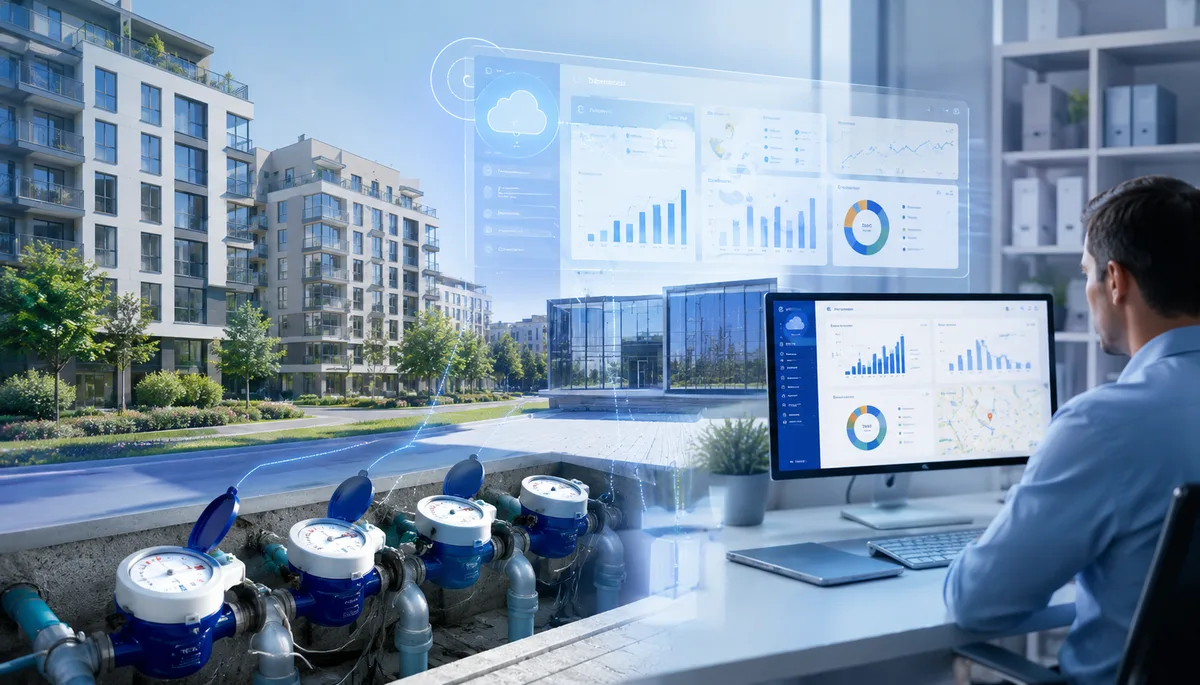
A smart water meter project is more than swapping in a meter with a communication module. The complete solution — the meter, communication network, data platform, billing integration, installation workflow, and long-term maintenance plan — has to work together, or even a technically sound meter will fail to deliver reliable billing data.
This guide walks through how a utility plans, selects, tests, and deploys a smart water metering solution: from defining project objectives and auditing existing assets, to comparing meter and communication technologies, preparing a tender, and verifying installations after the fact.
What Is a Smart Water Meter, and What Is a Smart Water System?
A smart water meter measures water consumption and reports it through an electronic or communication interface. Depending on the design, it may also report interval consumption, reverse flow, continuous-flow or leakage indication, low-battery status, tamper events, and valve or communication status. The U.S. EPA notes that this kind of advanced metering infrastructure lets utilities collect water-use data more frequently and accurately, supporting billing, leak detection, and resource management.
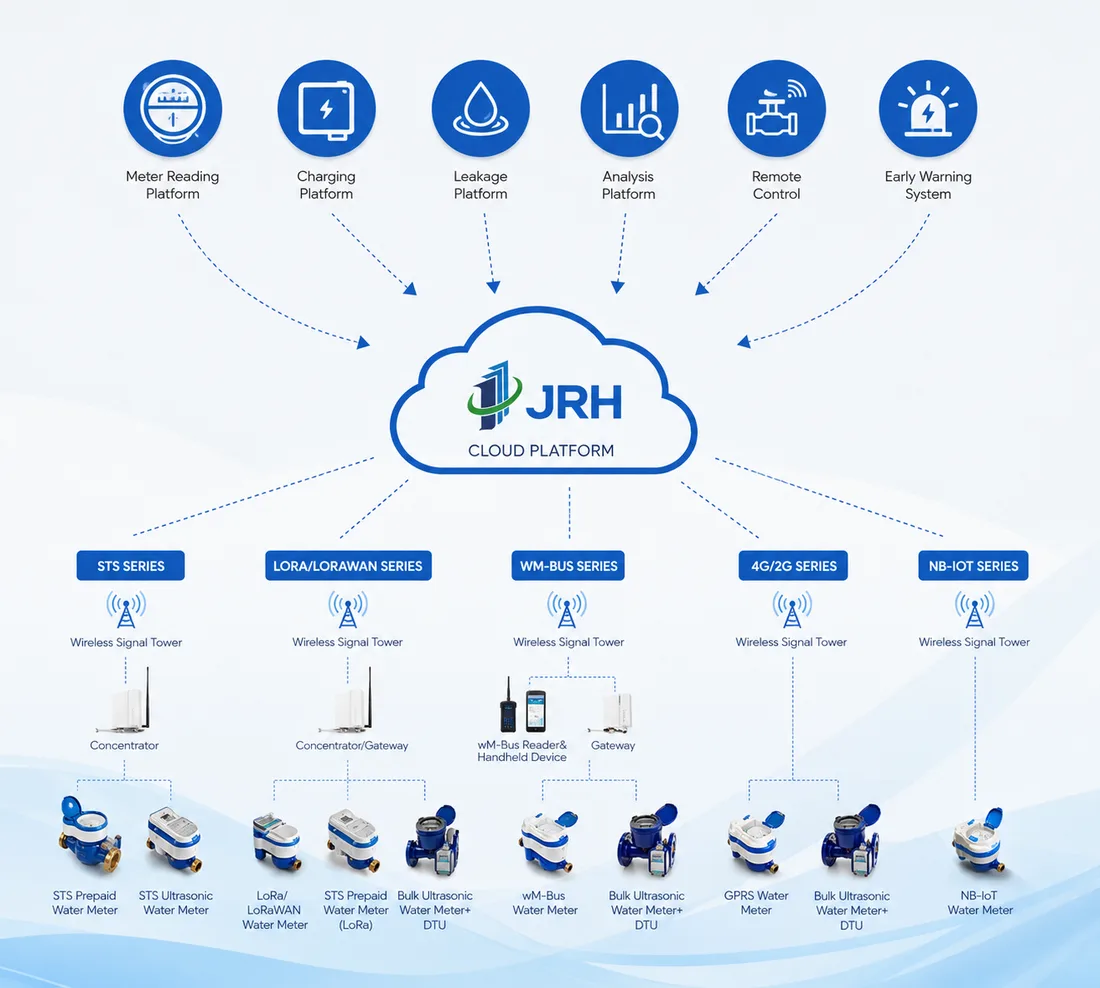
A meter, however, is not the same thing as a system. A smart water meter can produce data; a smart water metering system is everything required to collect, transmit, store, and act on that data. That system is generally built from five layers:
| Layer | What it does |
|---|---|
| Measurement | The meter itself measures flow — mechanically, volumetrically, via photoelectric direct-reading, or via ultrasonic sensing |
| Communication endpoint | Reads the meter and prepares data for transmission, either built into the meter or added as a module |
| Communication network | Carries data to the collection platform — RS-485, M-Bus, pulse, RF, LoRa/LoRaWAN, NB-IoT, or cellular |
| Data platform | Receives readings, alarms, and device status; may support inventory management, reports, remote valve control, and API access |
| Utility business systems | The billing, CIS, GIS, MDMS, and work-order systems the meter data ultimately needs to reach |
Buying thousands of smart meters doesn’t automatically produce a working smart water system. The project only succeeds once every meter is reliably linked to the right customer account, produces valid readings, and feeds that data into billing and operations — which is why the planning steps below start well before any meter is chosen.
AMR vs. AMI: What’s the Difference?
The two terms are often used loosely, but they describe different levels of system capability.
| AMR (Automatic Meter Reading) | AMI (Advanced Metering Infrastructure) | |
|---|---|---|
| Main purpose | Automate meter reading | Build a connected metering and data infrastructure |
| Typical collection | Walk-by, drive-by, wired, or scheduled remote reading | Fixed-network or cellular communication |
| Communication direction | Often one-way | Frequently two-way |
| Reading frequency | Periodic | More frequent interval data |
| Remote configuration / valve control | Limited or unavailable | May be supported |
| Data use | Primarily billing | Billing, customer service, analytics, and operations |
| Infrastructure complexity | Lower | Higher |
AMR reduced the need for manual reading by allowing collection from a distance, including drive-by systems. AMI extends that by supporting more frequent data and a wider range of applications — at the cost of more integration and network complexity. Because suppliers don’t always apply these labels consistently, it’s worth evaluating what a proposed system actually does rather than relying on whether it’s marketed as AMR or AMI. For a practical overview, see JRH’s AMR water meter reading solution.
Why Utilities Deploy Smart Water Meters
Utilities rarely start a smart metering project for a single reason. One may be replacing an aging meter population; another is trying to cut estimated bills; a third is planning a citywide AMI rollout for better data visibility. Common objectives include:
- Reducing manual reading, especially where meters sit inside private properties, in underground pits, or across a large service area
- Improving billing accuracy and reducing estimated bills
- Detecting continuous flow or unusual consumption earlier
- Supporting non-revenue water management
- Giving customer service teams interval data to investigate billing disputes
- Adding remote valve control, where the meter and network support it
These objectives tend to cluster around three practical benefits. On the revenue side, more reliable meter identification and reading collection reduce transcription errors and estimated bills — though this depends on the account database and billing integration being correct, not just the communication link. Customer meter data also improves the water balance and can help flag under-registering meters, reverse flow, or suspected tampering, though distribution-level losses still need district meters, pressure monitoring, and network analysis on top of it.
On the operational side, more frequent data helps identify abnormal consumption before the next billing cycle — the actual detection capability depends on reading interval, alarm logic, and platform configuration, not just on having “smart” meters installed. Where the meter and network support two-way communication, utilities may also be able to open or close a valve, adjust reporting intervals, or request an on-demand reading remotely; these functions need to be defined during procurement, since not every technology supports them.
On the customer side, interval data lets a utility investigate exactly when a disputed consumption spike occurred, and a customer portal can let people track their own usage and catch a leak before it shows up as a large bill.
Planning the Project: Objectives, Team, and Asset Audit
The project should start with the utility’s own requirements, not a supplier’s meter catalog. A practical sequence runs from defining the problem and setting measurable objectives, through auditing existing assets and mapping the data flow, to comparing technology options, building a cost model, running a pilot, and only then deploying in controlled phases.
A utility focused mainly on getting reliable monthly billing data doesn’t need the same communication frequency or platform functions as one planning hourly consumption analytics and remote valve control — so the objective should be written down before anything is specified. Alongside it, the team should agree on measurable KPIs up front: meter-to-bill success rate, percentage of expected data records received, number of estimated bills, communication availability, and installation completion rate are common ones. Setting these before the pilot is what turns the pilot into an evidence-based decision rather than a demonstration.
Because a metering project touches billing, IT, customer service, field operations, and cybersecurity as much as it touches the meters themselves, it needs a cross-functional team from the start — the IT team reviewing protocols and API access, the billing team confirming that account and meter data can actually be exchanged, and so on.
Before any tender is written, the utility should also audit what’s already installed: meter inventory, age, customer type, installation location and orientation, meter box condition, pipe and valve condition, communication environment, and account information. A full audit isn’t always practical on a large system, but a representative sample — spanning different sizes, neighborhoods, and installation conditions — is usually enough to reveal problems, since replacing a meter can also mean replacing fittings, valves, boxes, or cables at some sites. The same review should extend to the underlying customer and account records: service address, account number, existing meter serial number, and billing multiplier all need to be correct before installation, or a technically fine meter can end up assigned to the wrong customer.
Building a Lifecycle Cost Model
The cheapest meter rarely produces the cheapest project. A realistic financial model needs to weigh capital costs, ongoing operating costs, and the benefits the project is meant to deliver.
Capital costs typically include the meters, communication modules, valves, gateways, installation labor, meter boxes and fittings, data platform setup, billing integration, pilot testing, and training. Operating costs are the recurring items that continue for the life of the system — SIM or LoRaWAN network service, platform subscription, server hosting, battery replacement, spare parts, and cybersecurity management. Against those costs, the expected benefits — lower routine reading costs, fewer estimated bills, faster billing, earlier leak detection, fewer unnecessary field visits — depend heavily on labor costs, meter condition, and the utility’s existing processes. A supplier’s universal savings percentage or battery-life claim is worth treating with some skepticism until the assumptions behind it are reviewed.
Selecting the Water Meter Hardware
Communication technology tends to get the most attention in an AMI project, but the meter is still the instrument that measures revenue — so the metrological and mechanical requirements should be settled before the communication module is chosen.
Mechanical, Photoelectric, and Ultrasonic Meters
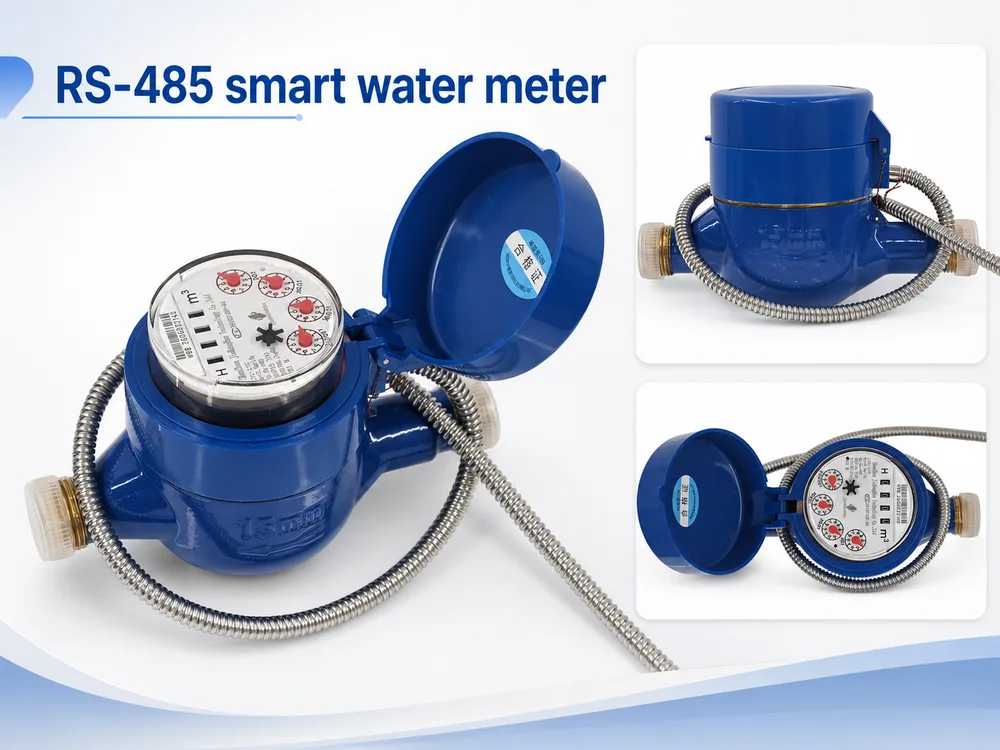
A mechanical smart water meter pairs a familiar mechanical measuring element with an electronic reading or communication module. It’s typically the lower-cost, more widely available option, and a natural fit for large residential rollouts — though sensitivity to water quality, mechanical wear, and low-flow performance still need evaluating, along with whether the communication module reads pulses or encoded digits directly.
A photoelectric direct-reading meter electronically reads the digits actually displayed on the mechanical register, rather than calculating consumption by accumulating pulses. Because it reports the current register value on request instead of a running pulse total, it avoids the permanent drift that can build up between the mechanical display and the remote reading when pulses are lost or miscounted. JRH offers photoelectric direct-reading meters with wired options such as RS-485 and M-Bus for building and centralized-reading applications.
An عداد المياه بالموجات فوق الصوتية measures flow electronically, with no mechanical element in the flow path — which removes mechanical wear, extends low-flow sensitivity, and can report instantaneous flow alongside event and status data. In exchange, it needs a more careful look at water quality requirements, full-pipe installation conditions, battery strategy, and long-term measurement verification. JRH’s ultrasonic models are available in different sizes, range ratios, and communication interfaces, with the exact combination confirmed per project.
| Mechanical smart meter | Ultrasonic smart meter | |
|---|---|---|
| Measurement principle | Mechanical moving element | Electronic ultrasonic measurement |
| Initial price | Often lower | Often higher |
| Mechanical wear | Present | None in the flow path |
| Low-flow capability | Depends on meter design | Often a key advantage |
| Data functions | Depends on register and endpoint | Often richer electronic data |
| Best fit | Cost-sensitive, established applications | Low-flow accuracy and electronic-function priorities |
Neither type is automatically the better choice — the right one depends on water quality, consumption profile, required accuracy, budget, and expected operating life, which is why this decision should be made before, not alongside, the communication decision. For a detailed comparison, read how to choose a smart water meter.
Key Specifications to Define
A handful of specifications determine whether a meter actually fits the project, and each is worth defining explicitly in the tender rather than left to a supplier’s default:
- Nominal diameter — required quantity for each size (DN15 through DN50+); residential, commercial, and industrial accounts shouldn’t be assumed to share one configuration
- Flow rates and range ratio — minimum (Q1), transitional (Q2), permanent (Q3), and overload (Q4) flow, plus the Q3/Q1 range ratio; a high published ratio only matters if the meter still suits the actual water quality and consumption profile
- Installation orientation — horizontal, vertical, or either; accuracy and range ratio can depend on orientation for some designs
- Body material — brass, cast iron, ductile iron, stainless steel, or approved polymer, chosen against local drinking-water rules, corrosion conditions, and pressure
- Environmental protection — IP rating verified for the complete assembly (cables, modules, connectors), not just the enclosure, particularly for underground or wet installations
- Power supply and battery life — driven by reading and reporting frequency, signal strength, retransmissions, and temperature; ask the supplier for its calculation assumptions rather than taking a stated battery life at face value
- Functions — whether reverse-flow detection, continuous-flow alarm, tamper alarm, valve control, or prepaid operation is required, since not every model supports every function
International references such as ISO 4064 and OIML R 49 set metrological requirements for water meters, but national or regional regulations always take precedence, and the current applicable edition should be confirmed for the project country.
Choosing the Communication Technology
There’s no single best communication method — the right one depends on the installation environment and the utility’s operating model.
| Technology | Typical application | Infrastructure responsibility | Key considerations |
|---|---|---|---|
| RS-485 | Buildings, apartments, campuses | Utility, owner, or integrator | Cabling, topology, address management, protocol consistency |
| M-Bus | Building metering, centralized reading | Utility, owner, or integrator | Bus capacity, addressing, collector compatibility |
| إخراج النبضات | Retrofits, existing data loggers | Integrator or utility | Limited data richness, risk of lost pulses |
| LoRa / LoRaWAN | Communities, campuses, regional networks | Utility, integrator, or network provider | Gateway coverage, frequency rules, proprietary LoRa vs. standards-based LoRaWAN |
| NB-IoT | Dispersed utility connections | Cellular operator and platform provider | Signal coverage at meter depth, SIM cost, power consumption |
| 4G / cellular | Selected remote applications | Cellular operator and platform provider | Frequency bands, data plan, device lifecycle |
| RF mesh | Dense municipal networks | Utility or managed-service provider | Endpoint density, collector placement, network redundancy |
For buildings, apartments, and campuses, RS-485 and M-Bus generally make sense because meters can be wired into a planned cable network with a predictable communication path — this is the segment JRH’s RS-485 and M-Bus meters are built around. Where meters are physically dispersed across a wide area instead, LoRaWAN أو NB-IoT tend to fit better, trading the wired predictability for coverage over distance.
Whatever technology is shortlisted, coverage maps and desktop calculations can’t fully represent conditions below ground, under metal lids, or inside reinforced concrete. A field test on the actual meter configuration — recording signal level, successful transmission rate, retries, and recovery after an interruption — is what turns a theoretical coverage estimate into a confirmed one. For a full breakdown of wired vs. wireless tradeoffs, see عدادات المياه الذكية السلكية مقابل اللاسلكية.
Data, Software, and System Integration
The data path for any smart metering project runs: water meter → communication endpoint → gateway or operator network → head-end platform → meter data system → billing or utility application — and before procurement, the utility should know which supplier is responsible for each link in that chain.
A physical interface doesn’t guarantee compatibility on its own. Two meters can both use RS-485 and still be unable to exchange usable data if their protocol definitions don’t match — so the tender should specify the actual protocol (Modbus, M-Bus data format, a utility-specific protocol, or API access), not just the wire standard. On the billing side, the utility needs to define which readings feed billing, how meter exchanges get recorded, how old and new serial numbers are matched, and how exceptions and corrected data are handled — and this should be tested end-to-end, confirming that data from an installed meter actually appears under the correct customer account, before the full rollout begins.
Cybersecurity requirements should cover the whole system, not just the meter — device identity and authentication, encryption in transit and at rest, role-based access, firmware update process, and incident response all belong in the review, with particular attention to remote valve control, since an unauthorized command there could affect water service.
Preparing the Tender and Evaluating Suppliers
An effective tender describes what the utility actually needs without forcing every supplier into one proprietary architecture. At minimum, it should cover project information (country, connection count, customer categories, schedule), the required quantity by diameter and application, the full meter specification (technology, flow rates, material, IP rating, functions, standards), the communication and platform requirements, documentation requests (datasheets, test reports, certificates, battery-calculation assumptions), sample and pilot requirements, and delivery and warranty terms.
Once proposals come in, the supplier itself is worth evaluating on more than unit price. A supplier should be able to explain its measurement principle, communication architecture, and alarm logic in specific terms — not just marketing language — and should be willing to provide samples for verification of dimensions, accuracy, protocol, and collector compatibility before a large batch is ordered. On the manufacturing side, it’s worth reviewing incoming material inspection, calibration, pressure and waterproof testing, and serial-number traceability, because batch consistency is often where large projects run into trouble: different production batches ending up on different firmware, communication parameters, or encryption keys can silently break parts of a rollout. A contract clause requiring configuration records and approval before any change is a simple way to guard against that.
Piloting, Deploying, and Verifying the System
A pilot should reproduce the conditions the full rollout will face, not just the easiest ones — a representative mix of residential and commercial connections, different meter sizes, indoor and underground installations, and weak-signal or high-rise locations. Acceptance criteria should cover the whole meter-to-bill chain: accuracy, reading success rate, data completeness, alarm accuracy, valve-command success, and billing reconciliation, not simply whether a meter can send one reading. Findings should be sorted into what’s accepted as-is, what needs a configuration change, and what requires product, network, or software rework — with anything changed after the pilot retested before it’s carried into the full deployment.
For the rollout itself, a phased approach — pilot, then one representative area, verify installation and billing, correct the workflow, then expand — controls risk better than a single big-bang deployment. During the transition, the utility typically needs to run legacy and smart-meter reading side by side, with a clear rule for which system is the billing source for each account and how the final old-meter reading is recorded. Not every meter gets replaced on the first visit either — locked properties, damaged meter boxes, and missing account records are routine exceptions, and the project needs an owner and a tracking method for each one, along with a complete exchange record (old and new serial numbers, final and initial readings, GPS location, photographs) for every meter that is replaced.
Installation itself isn’t finished until the data is verified. Four checks confirm that:
| Check | What to confirm |
|---|---|
| Mechanical | Correct size, flow direction, orientation, no leakage, valve operation, correct initial reading |
| Device | Correct serial number, endpoint, communication address, firmware, and account assignment |
| التواصل | Platform is actually receiving the reading, timestamp, device identity, and alarm data |
| Billing | Reading appears under the right customer, multiplier is correct, old and new readings reconcile |
Skipping this step is how a meter ends up physically installed and still invisible to billing — a problem that, without active monitoring, may not surface until the next billing cycle.
Once meters are live, the work shifts to ongoing monitoring: comparing expected readings against received ones, tracking repeated communication failures, and classifying non-reporting meters by likely cause — network outage, weak signal, battery, or account mapping error. Remote communication doesn’t replace meter accuracy management either; periodic verification and failure analysis should continue on the same schedule they always did. Battery and device replacement planning should be based on actual field data (signal conditions, valve use, seasonal temperature) rather than a brochure figure, and before adding new meters or changing suppliers, protocol compatibility, API access, and data ownership are worth confirming in writing rather than taking a “future-proof” claim at face value.
How JRH Supports Smart Water Meter Projects
JRH works with utilities, distributors, engineering companies, and tender participants on water meter selection and project configuration — reviewing tender specifications, matching meter technology to the application, confirming sizes and flow requirements, and comparing mechanical, direct-reading, and ultrasonic options against the installation environment. Support extends through sample preparation, communication parameter confirmation, and maintaining an approved configuration through batch production, packaging, and export documentation.
JRH’s current range includes mechanical, photoelectric direct-reading, and ultrasonic meters, with selected models supporting RS-485, M-Bus, LoRa, LoRaWAN, NB-IoT, and 4G communication — but the exact meter and communication combination should always be confirmed against the project’s technical requirements rather than assumed from a product name. Before recommending a configuration, JRH reviews the installation environment, meter quantity and size distribution, required reading frequency, existing data platform, and delivery schedule.
To get an accurate recommendation, it helps to send the project country and type, meter quantity and sizes, preferred measurement and communication technology, installation environment, existing platform and protocol, required alarms and valve control, and delivery schedule — for a tender project, the original technical specification is usually the most useful starting point. Contact JRH to discuss your project requirements.
Frequently Asked Questions
Are all smart water meters ultrasonic?
No. Smart water meters can use mechanical, volumetric, photoelectric direct-reading, ultrasonic, or other measurement technologies. “Smart” refers to the data and communication functions, not one specific measurement principle.
Is AMI always better than AMR?
Not necessarily. AMI provides more frequent data and broader functions, but with greater integration and network-management overhead. A utility that only needs automated periodic readings may find a simpler AMR system meets its needs at lower cost.
Do smart water meters provide real-time data?
Some provide near-real-time or frequent interval data, but not every meter transmits continuously — the result depends on the measurement interval, reporting schedule, network, and power strategy, so a tender should specify the actual required interval rather than relying on the phrase “real-time.”
Can a smart water meter connect to an existing billing system?
Possibly, but compatibility has to be verified — matching data format, protocol, meter identifiers, and billing multipliers. A communication-ready meter doesn’t automatically integrate with every billing platform.
How long does a smart water meter battery last?
There’s no single figure that applies across projects; battery life depends on reporting frequency, signal quality, valve use, temperature, and storage conditions before installation. Ask for the supplier’s calculation assumptions and confirm performance during the pilot.
Should a utility replace every meter at once?
Usually not. A phased rollout reduces risk and lets the utility fix communication, installation, and integration problems before scaling up — as long as there’s a clear plan for reading and billing old and new meters side by side during the transition.
Can JRH customize a smart water meter for a tender?
JRH can review tender requirements and evaluate meter, communication, protocol, and configuration options; feasibility depends on the required quantity, technical specification, certification, and project schedule.
Conclusion
A successful smart water metering project is decided before a meter is ever selected — by defining what the utility wants to achieve, auditing what’s already installed, and mapping how data needs to travel from the meter to the billing system. From there, the choice of measurement technology, communication network, and supplier follows naturally. The most reliable procurement decision is rarely the lowest meter price or the newest communication technology; it’s whichever combination produces accurate, secure, usable data for as long as the system needs to run.
Planning a smart water meter project or responding to a tender? Send JRH your project specifications for a preliminary meter and communication review.
مقالات ذات صلة: How to Choose a Smart Water Meter | Wired vs. Wireless Smart Water Meters | حل قراءة عدادات المياه من AMR | حلول القياس الذكية لاستهلاك المياه في المنازل