
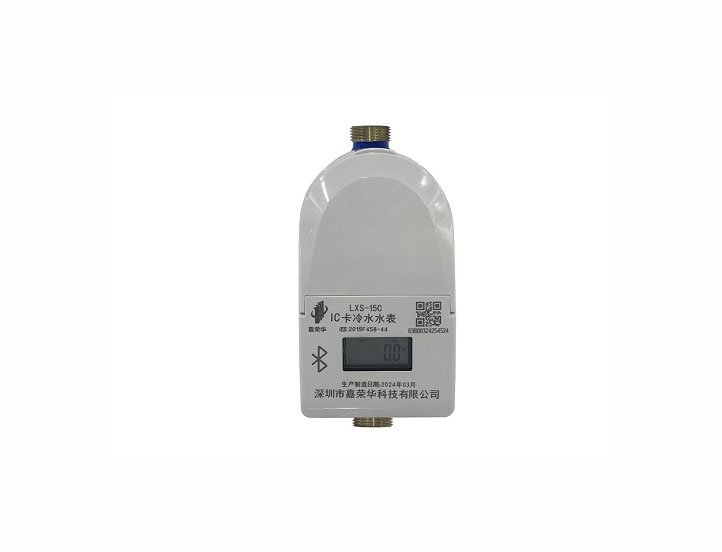
Why are more and more projects opting for Bluetooth scan-to-recharge water meters?
Compared to traditional mechanical water meters and high-cost NB-IoT remote solutions, Bluetooth scan-to-recharge water meters demonstrate significant advantages in cost, stability, and feasibility:
- Low retrofitting cost, no wiring or concentrators required
- Prepaid management, completely eliminating “payment delinquency issues”
- Simple operation, easy for the elderly to use
- Stable and reliable, unaffected by network signals
- Mature technology with multiple layers of security protection
- Flexible adaptation, supporting various management models
Core Technology Analysis: Is It Truly Stable and Reliable?
Most customers are less concerned about “how smart it is” and more about “whether it can operate stably over the long term.” Key technical assurances of Jiaronghua Bluetooth scan-to-recharge water meters:
- Photoelectric direct-reading technology ensures accurate readings without errors
Utilizes infrared photoelectric sensors to directly recognize digit wheel numbers, unaffected by fog, dirt, or misalignment, achieving a reading accuracy rate of up to 99.8%. - Bluetooth 5.0 low-power communication ensures stable transmission
Equipped with a Bluetooth 5.0 module, supporting a transmission range of 8–10 meters (in open environments) and encrypted transmission to ensure secure recharging. - Anti-magnetic attack and valve self-check for guaranteed security
Features strong magnetic interference detection; automatically closes the valve and reports anomalies upon detecting external magnetic interference. Monthly automatic valve switch tests prevent jamming due to prolonged inactivity. - Large-capacity battery with a lifespan of over 6 years
Uses high-quality lithium batteries with a static power consumption as low as 5μA. Under normal usage conditions, the battery life can reach 6–8 years. - Supports tiered pricing and balance alerts
Allows preset multi-tier water prices, with the system automatically accumulating water usage and charging accordingly. Alerts users automatically when the balance is low.
Typical Application Scenarios: Where Is It Suitable?
- Retrofitting projects in old residential communities
No need to replace pipelines, wiring, or build concentrators. Simply replacing the water meters enables prepaid management, with short retrofitting cycles and low costs. - Talent apartments & long-term rental apartments
Landlords or operators can centrally manage hundreds of units. Tenants can scan to use, avoiding payment disputes and improving operational efficiency. - School dormitories & factory dormitories
Supports fixed-quota water usage and excess charging modes, effectively controlling water waste and fostering conservation awareness among students/employees. - Hospital logistics & office building management
Enables independent water cost accounting for departments, providing data support for energy consumption assessments. - Rural centralized water supply points
Combines WeChat Pay and Bluetooth recharge to address challenges in meter reading and fee collection in rural areas, promoting integrated urban-rural water supply.
Feedback from Real Projects: Data Speaks for Itself
In multiple implemented projects, Jiaronghua Bluetooth scan-to-recharge water meters have performed exceptionally:
- An old residential community in Shenzhen (860 households): After retrofitting, the delinquency rate dropped from 22% to 4%, and property management labor input decreased by 70%.
- A talent apartment in Hangzhou (320 units): Tenants recharged an average of 1.2 times per month, with 95% of transactions completed via mobile phones, achieving a 98% satisfaction rate.
- A vocational college in Chengdu (5 dormitory buildings): Water fee recovery rate increased to 100%, with annual water savings of approximately 12,000 tons.