

2,500 DN15 RS-485 Smart Water Meters for a Residential & Commercial Project in Campinas, Brazil
A Brazilian water equipment and engineering company needed to replace manual meter reading with a centralized data collection system across its residential and commercial building projects in Campinas, Sao Paulo. After comparing suppliers, the customer selected JRH Meter to supply 2,500 DN15 brass-body RS-485 smart water meters, along with communication configuration, sample verification, batch production and export support.
This Brazil water meter project shows what a full-service RS-485 water meter supplier can offer beyond hardware alone — product selection, communication testing and a water metering solution built around the customer’s own platform, delivered as one coordinated order.
Project Overview
| Item | Project Details |
|---|---|
| Project location | Campinas, Sao Paulo, Brazil |
| Customer type | Water equipment and engineering company |
| Application | Residential and commercial buildings |
| Product | DN15 brass-body photoelectric direct-reading smart water meter |
| Quantity | 2,500 units |
| Communication | RS-485 (Modbus-based) |
| Meter reading method | Centralized remote meter reading |
| Installation | Horizontal |
| Waterproof rating | IP68 |
| Supplier | JRH Meter |
Why the Customer Moved to RS-485 Remote Reading
Manual meter reading requires staff to visit every building, record each reading by hand, and transfer the data into a billing system. Across a project with thousands of meters, this process is slow and prone to delayed readings, duplicated work, and data-entry errors — problems that scale badly once multiplied across 2,500 installation points.
The customer needed a way to collect readings from many meters at once and feed them into a single management platform. RS-485 was the natural fit: it’s a wired bus protocol well suited to in-building networks, where multiple meters share one communication line back to a data concentrator. The resulting system architecture was straightforward —
DN15 RS-485 smart water meters → RS-485 communication bus → data concentrator → customer’s management platform → centralized remote reading
Because this approach worked with the customer’s existing platform, it avoided the cost and disruption of building a new software system from scratch.
JRH’s Recommended RS-485 Water Meter for Brazil: DN15 Photoelectric Direct-Reading
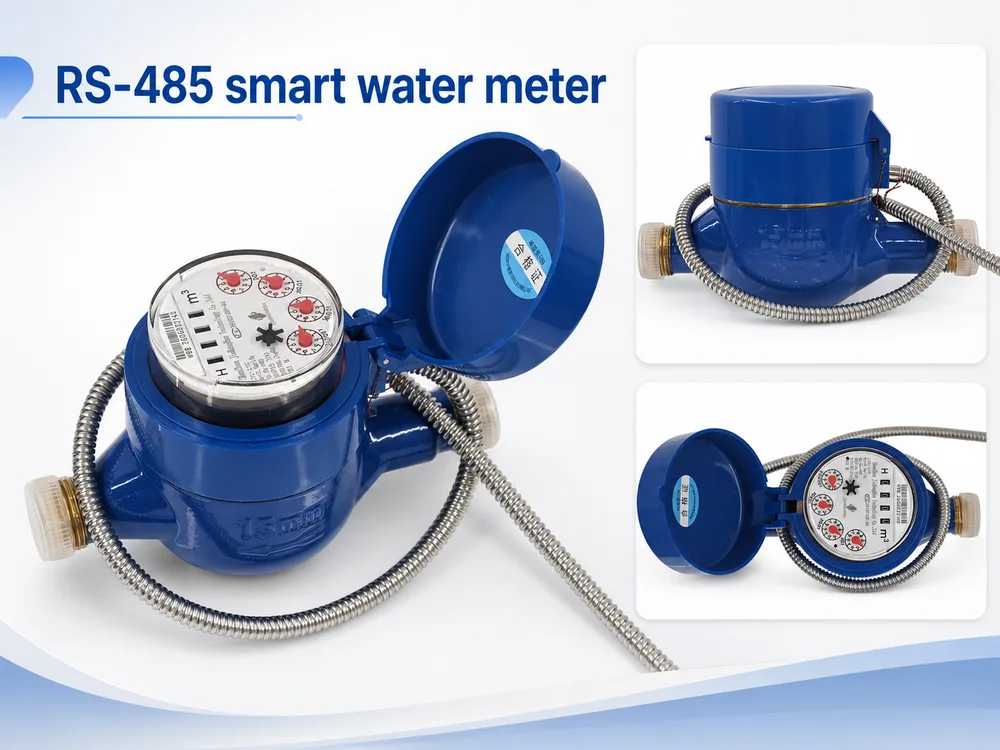
Based on the installation environment, order volume, and communication requirements, JRH recommended a DN15 brass-body photoelectric direct-reading RS-485 smart water meter — a design that pairs a standard mechanical register with an electronic reading module, so the meter can be checked visually on-site while still reporting data remotely.
Photoelectric Direct-Reading vs. Pulse-Output
Both technologies report consumption electronically, but they arrive at the number differently — which matters for a batch this size, where even small discrepancies get multiplied across 2,500 meters.
| Photoelectric Direct-Reading (Selected) | Pulse-Output | |
|---|---|---|
| How it works | Optically reads the actual digits on the mechanical register when data is requested | Counts pulses generated by a rotating mechanism and accumulates them into a total |
| Accuracy risk | Reflects the register value directly — no drift | Can drift from the true reading if pulses are lost or miscounted |
| Power use | Draws power mainly when queried, supporting stable long-term operation | Typically requires more continuous signal processing |
| Local inspection | Mechanical register stays readable on-site | Not always paired with a visible register |
The brass meter body was selected for durability in building water supply systems, and every unit carries IP68 waterproof protection — important given that meters would sit in humid utility rooms and meter boxes across multiple buildings with varying conditions.
Matching Communication to the Customer’s Existing Platform

Supplying a mechanically sound meter wasn’t enough — it also had to talk correctly to the customer’s platform, which ran on a Modbus-based structure. Before production began, JRH’s technical team worked through the details with the customer:
- RS-485 interface configuration and wiring requirements
- Communication baud rate and meter addressing
- Data-reading commands and register data format
- Communication protocol and data mapping to the platform
- Connection method with the data concentrator
- Meter reading intervals
Confirming these points up front meant the customer wasn’t at risk of receiving 2,500 meters that were physically correct but unable to communicate with its existing system.
From Sample Testing to Mass Production
JRH did not move straight to full production. Sample meters were built to the confirmed specification first, and the customer tested them on two fronts before approving mass production:
- Metering performance — flow measurement, accuracy, pressure, sealing, register reading, and body/connection inspection
- Communication — RS-485 connection, address configuration, data-reading verification, protocol matching, and live connection to the customer’s management platform
Only after both sets of tests passed did the customer sign off on the final configuration for the full 2,500-unit order.
Batch consistency was treated as seriously as individual meter performance during production. JRH controlled the brass body inspection, register assembly, photoelectric module installation, RS-485 configuration, and meter address allocation throughout the run, with batch sampling on metering accuracy, pressure, sealing, and communication stability. The priority was making sure no portion of the shipment ended up with mismatched communication parameters that the customer’s data concentrator couldn’t recognize.
Packaging, Documentation, and Delivery
Once production and final inspection were complete, JRH packed the meters to protect the brass bodies, registers, and communication cables during international shipping. The delivery included:
- 2,500 DN15 RS-485 smart water meters and connection accessories
- Product manuals and RS-485 wiring instructions
- Communication protocol documentation
- Packing lists and export shipping documents
Everything the customer’s local installation team needed to wire and configure the meters correctly on site was included in a single coordinated shipment.
Value Delivered
For the customer, this project was less about replacing individual meters than about building a manageable, centralized water data process across many buildings. With the RS-485 network in place, readings could be pulled through the data concentrator instead of collected door-to-door, cutting the routine workload down to occasional on-site checks rather than full manual rounds.
Because the communication layer was tested and confirmed before production, the new meters slotted into the customer’s existing platform rather than forcing a system replacement — and because all 2,500 units shipped to the same verified configuration, installation and maintenance stayed consistent across the whole project.
Part of a Wider Shift Toward Smart Metering in Brazil

This project reflects a broader move underway across Brazil, where water utilities and property managers are steadily replacing manual meter reading with automated systems. At the city-utility scale, some operators have rolled out wide-area IoT networks connecting well over 100,000 meters across an entire metropolitan area, with each meter reporting individually over a long-range wireless network back to a central platform.
Building-level projects like this one call for a different architecture. Instead of each meter connecting independently over a citywide network, RS-485 lets the meters within a building or property share a single wired bus back to a local data concentrator — a setup that fits the density of a residential or commercial building far better than a wide-area network. For more on choosing the right approach, see our guide on wired vs. wireless smart water meters.
Why the Customer Chose JRH
The project needed more than a manufacturer that could produce a standard water meter — it needed a supplier that could recommend the right product, validate communication compatibility, and hold quality steady across a large batch. JRH Meter covered each stage: product selection based on the installation environment and platform requirements, communication configuration and testing with the customer’s technical team, controlled mass production with batch-level quality inspection, and full export support from packaging through shipping documentation — giving the customer one point of contact for the entire order rather than separate vendors for hardware and integration.
Looking for a Smart Water Meter Supplier in Brazil?
JRH supplies photoelectric direct-reading RS-485 water meters for residential buildings, apartments, commercial facilities, and centralized meter reading projects across Brazil and other international markets, with:
- DN15 to DN40 sizes, brass meter bodies
- RS-485 or M-Bus communication
- Customer-specified communication protocols
- Sample testing, bulk production, and OEM/project customization
- Export documentation support
For your next Brazil water meter project, send JRH your required quantity, pipe diameter, communication protocol, and management platform details, and our team will help configure a suitable water metering solution.
Related reading: How to Choose a Smart Water Meter? Clarify These Points First | Smart Water Meters: Wired or Wireless? | AMR Water Meter Reading Solution | Residential Smart Water Metering Solution