
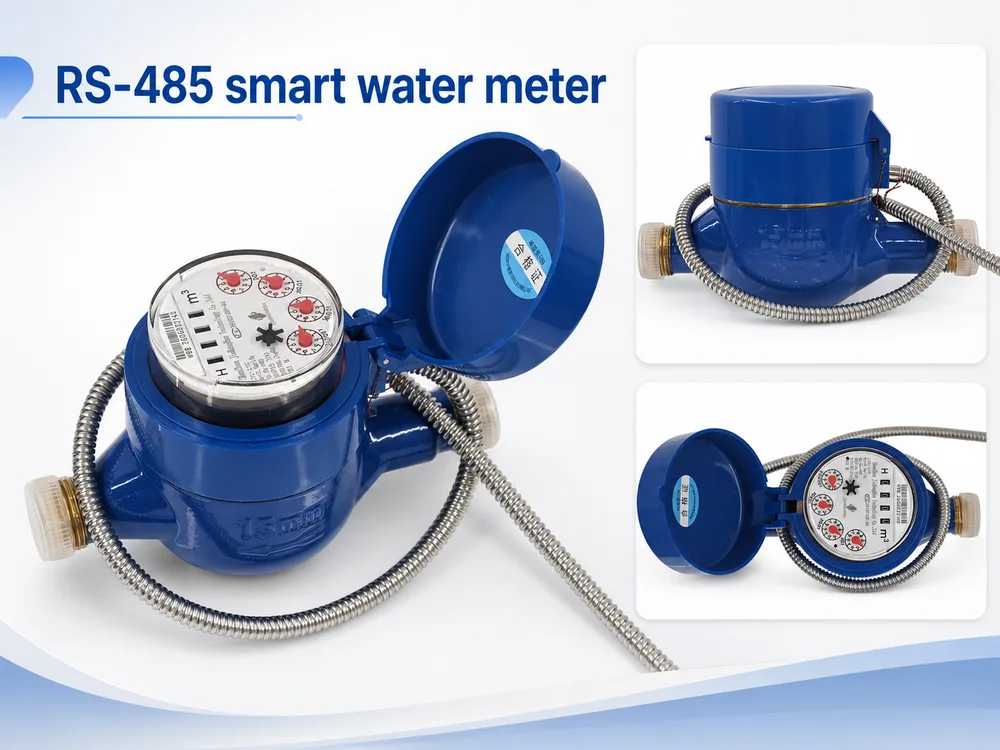
A smart water meter measures water consumption, converts the reading into digital data, and transmits that data to a remote collection or management system. What makes a meter “smart” is not one specific sensor — it is the combination of a measuring element, a microcontroller, and a communication module that lets the reading travel from the pipe to a software platform without anyone visiting the site.
At Измеритель JRH, this is also the order in which most customers actually evaluate a project: how the meter measures water, how that reading becomes digital data, how the data reaches the utility, and finally what the utility or property manager can do with it. This article follows the same sequence.
How Do Smart Water Meters Measure and Digitize Water Flow?
Every smart water meter starts with a measuring element that responds to the physical movement of water, and an encoder or sensor that turns that response into an electrical signal.
A mechanical meter with pulse output keeps the traditional impeller or piston mechanism, but adds a sensor that generates one electrical pulse for every fixed volume of water — for example, one pulse per liter or per ten liters. This is the simplest and most economical way to digitize a reading, and it is easy to retrofit onto existing installations. Its main limitation is that a lost or miscounted pulse affects the calculated total, and basic pulse output does not report the actual register value.
A photoelectric direct-reading meter solves that specific problem. Instead of only counting pulses, an optical module reads the physical position of the mechanical register itself, so the digital reading always matches what is printed on the dial — even after a communication interruption. This is why photoelectric meters are common in centralized reading projects such as apartment buildings, where reading synchronization across many meters matters more than raw cost.
Ultrasonic meters measure flow without any moving parts. Two ultrasonic signals travel through the water — one with the flow, one against it — and the meter calculates flow velocity from the difference in their travel time. Because there is nothing mechanical to wear out, ultrasonic meters tend to perform well at low flow rates and support digital data collection at high frequency, though the electronics require careful calibration and the installation conditions (air bubbles, pipe condition) can influence accuracy.
Electromagnetic meters work on a different principle: as conductive water passes through a magnetic field inside the measuring tube, it generates a voltage proportional to its velocity. This technology has no moving parts either and handles larger pipe diameters well, which is why it appears more often in municipal and industrial flow measurement than in small residential meters.
| Technology | How It Measures | Best Suited For |
|---|---|---|
| Mechanical with pulse output | Counts electrical pulses from a mechanical register | Residential submetering, basic AMR upgrades |
| Photoelectric direct reading | Optically reads the actual register value | Apartments and buildings needing centralized, synchronized reading |
| Ultrasonic | Compares transit time of signals with and against flow | Residential, commercial and utility metering, low-flow accuracy |
| Electromagnetic | Measures voltage from conductive water in a magnetic field | Larger pipes, municipal and industrial systems |
No single technology is correct for every project — the right choice depends on pipe diameter, water conditions, required accuracy, and budget, which is why Измеритель JRH reviews these factors with customers before recommending a measurement type rather than defaulting to one.
Once the reading is digitized, a microcontroller inside the meter processes and stores it — typically total consumption, interval consumption, instantaneous flow, and status flags such as reverse flow, low battery, or suspected leakage. Recording frequency varies by product: some meters log every few minutes, others hourly or daily. A higher frequency gives more detailed data but also uses more power and generates more communication traffic, so this is a setting to configure deliberately rather than maximize by default.
How Does the Reading Reach the Utility or Management Platform?

The stored reading still has to travel from the meter to a data platform, and this is where wired and wireless communication technologies diverge — each fits a different installation pattern.
RS-485 is a wired bus standard where multiple meters connect along one cable back to a data collector. Because it does not depend on cellular or radio coverage, RS-485 is a reliable choice for apartment buildings, residential communities, and centralized meter rooms with high meter density — the tradeoff is that cabling must be planned and installed correctly, which raises cost in buildings that are already complete.
M-Bus serves a similar purpose but is purpose-built for utility metering, and can carry water, heat, and gas meters on the same collection network. It is a strong fit for building-level centralized reading where meter and collector compatibility have been verified in advance.
LoRaWAN removes the cabling requirement by sending data wirelessly from each meter to a gateway, which then forwards it to a network server. Its long range and low power consumption make it attractive for communities, campuses, and city-wide projects with many battery-powered meters — but the entire system depends on gateway coverage. Underground meter boxes, thick concrete walls, and metal covers can all weaken the signal, so gateway placement has to be tested under real installation conditions, not assumed from a spec sheet.
NB-IoT takes a different approach: each meter connects directly to a mobile operator’s network, so a project-level gateway is usually unnecessary. This makes NB-IoT well suited to meters that are widely distributed across a large service area, provided local operator coverage — including underground — has actually been confirmed, and the ongoing SIM or data cost has been budgeted.
Beyond these four, a few other technologies appear in specific situations: RF mesh lets meters relay data through neighboring devices, which suits dense urban networks but requires more careful planning; cellular (4G/LTE Cat.1) connections are typically reserved for large commercial meters or gateways transmitting higher data volumes; and Wi-Fi, while occasionally used indoors, is rarely the right choice for utility-scale deployment because coverage is limited underground and the network depends on someone else’s router.
| Коммуникация | Network Type | Main Advantage | Main Consideration |
|---|---|---|---|
| RS-485 | Wired bus | Stable, no wireless dependency | Requires planned cabling |
| M-Bus | Wired metering bus | Built for utility meter collection | Capacity and device compatibility |
| LoRaWAN | Meter-to-gateway wireless | Long range, low power | Gateway coverage must be tested |
| NB-IoT | Direct cellular | No local gateway needed | Operator coverage and service fees |
| RF mesh | Multi-device wireless | Multiple communication paths | Requires dense network planning |
| Cellular | Direct operator connection | Flexible, wide availability | Higher power draw, data cost |
| Wi-Fi | Local wireless | Simple in controlled buildings | Depends on customer’s network |
Gateway-based systems (LoRaWAN, RF mesh) and direct-to-network systems (NB-IoT, cellular) also represent two different infrastructure philosophies. A gateway-based system can lower the per-meter communication cost but adds gateway installation and maintenance as an ongoing responsibility. A direct-to-network system removes that local infrastructure but makes every meter dependent on operator coverage and service continuity. Измеритель JRH supplies meters across both models — RS-485, M-Bus, LoRaWAN и NB-IoT — because the right structure genuinely depends on meter density, coverage, and how a project wants to manage long-term maintenance, not on which technology sounds newest.
Whichever path the data takes, it eventually reaches a meter data platform, which may pass it on to billing systems, GIS, property management software, or customer-facing apps. The platform — not the meter alone — is usually what turns raw readings into alerts, reports, and billing calculations.
What Is the Difference Between AMR and AMI?
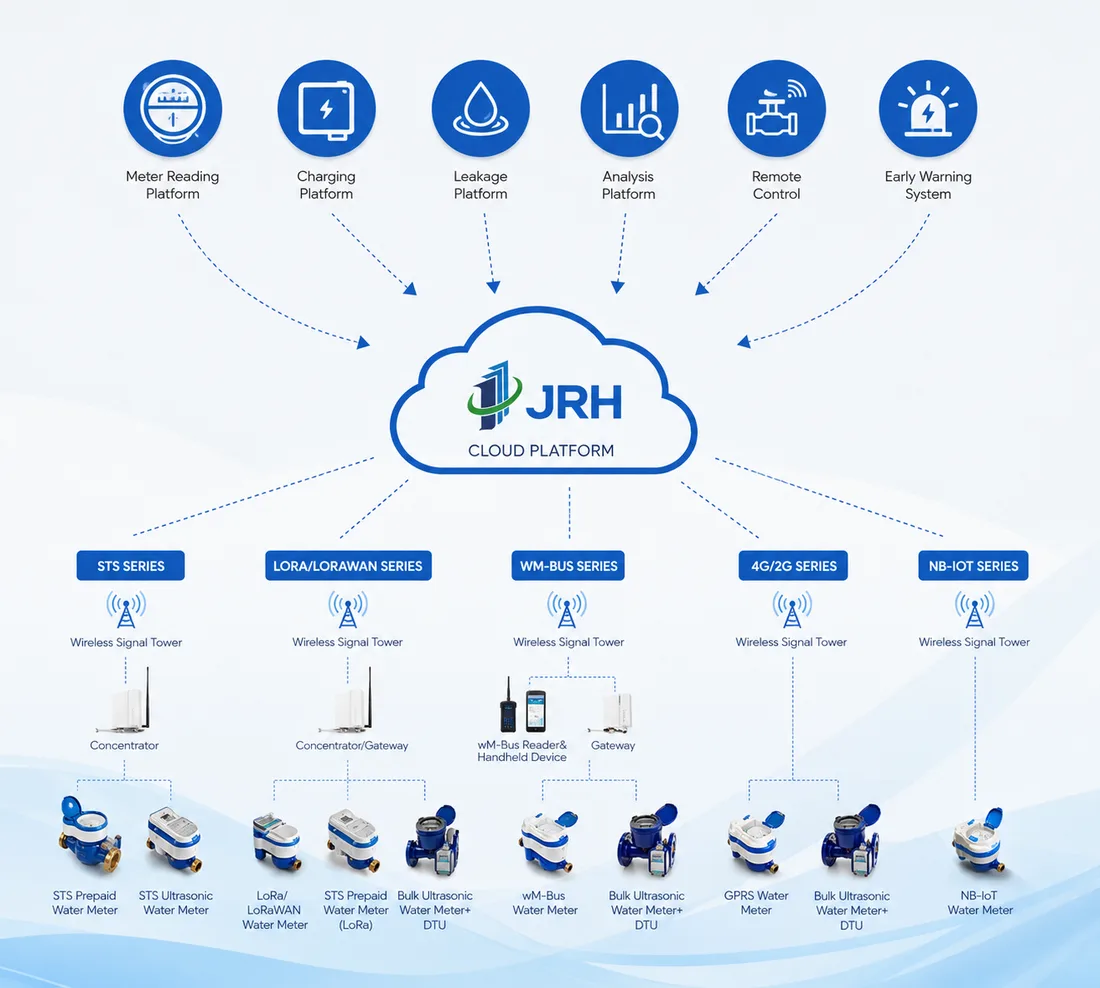
These two terms are often used loosely, but they describe different levels of system capability.
AMR (Automatic Meter Reading) is focused narrowly on collecting readings without a manual visit — through walk-by, drive-by, handheld, or wired collection methods. It reduces field labor but typically delivers infrequent, one-way data.
AMI (Advanced Metering Infrastructure) describes a full, continuously connected system: smart meters, a fixed communication network, gateways or collectors, data management software, and — often — bidirectional communication that supports alerts, analytics, and even remote valve control.
| Feature | AMR | AMI |
|---|---|---|
| Main purpose | Automatic collection of readings | Connected data collection, management and analysis |
| Data frequency | Usually lower | Usually more frequent |
| Коммуникация | Meter-to-reader or meter-to-system | Often bidirectional |
| Main functions | Remote reading, billing input | Reading, alerts, analytics, integration, optional control |
In practice, the line between them is not absolute — a project’s real capability depends on the specific meter, protocol, and software involved, so this label matters less than confirming what a given system can actually do before committing to it. For more on system architecture, see our AMR water meter reading solution page.
How Do Smart Water Meters Detect Leaks?
A smart water meter cannot see or locate a physical crack in a pipe. What it can do is flag consumption patterns that commonly indicate a leak, and hand that flag to the platform for a human to investigate.
The most common signal is continuous flow: if a home or property shows a small but uninterrupted flow for several hours — a period when usage should normally fall to zero — the system can flag possible leakage from a running toilet, dripping tap, damaged internal pipe, or a stuck irrigation valve. A sudden spike in flow points to a different kind of event, such as a burst pipe, and typically triggers an alert when usage crosses a defined threshold. Night-flow analysis applies the same logic at the district or building level, where persistent flow during low-usage hours can indicate background leakage. Software can also compare current use against a property’s own history, similar properties, or seasonal patterns, and flag any significant deviation.
What this analysis cannot do is just as important to understand: it cannot pinpoint the physical location of a leak, confirm its cause, or replace physical inspection. A suspected-leak alert is a starting point for investigation, not a diagnosis.
What Are the Benefits of Smart Water Meters?
For utilities, the clearest benefit is removing the need to send staff to every meter for a manual read, which frees that labor for maintenance and customer service instead. Because readings arrive more frequently, abnormal consumption — a leak, an unauthorized connection, a stuck valve — surfaces sooner than it would on a monthly manual cycle, and billing itself becomes more accurate since it is based on actual collected data rather than estimates. The same data also supports broader planning: identifying non-revenue water, forecasting demand, and prioritizing meter replacement by area or customer category. Where meters include a controllable valve and the software supports it, utilities can also manage prepaid accounts or shut off service remotely — though this depends on having both the right hardware and the right platform, not on the meter alone.
For customers, the benefit is largely visibility: many platforms let customers see their own consumption trends rather than a single number once a month, which makes it easier to catch a leak early or judge whether a change in habits is actually saving water. Bills are also less likely to rely on estimates, and customers no longer need to provide site access for routine reads.
These are also not benefits limited to municipal utilities — apartment submetering, commercial buildings, hotels, and industrial parks rely on the same underlying system to generate centralized reading and tenant-level billing data. Измеритель JRH‘s mechanical, photoelectric, ultrasonic and RS-485/LoRaWAN/NB-IoT product lines are used across exactly this range, from single utility deployments to multi-building commercial projects.
How to Choose the Right Meter and Communication Method
Meter selection should start from the application, not from a preferred technology. Utility billing, residential submetering, industrial process monitoring, and prepaid water management each carry different requirements for accuracy, data frequency, and valve control, so defining the application first narrows every decision that follows.
From there, a few checks determine the rest of the design:
- Measurement technology — chosen from mechanical pulse, photoelectric, ultrasonic, or electromagnetic based on pipe size, water conditions, and required accuracy.
- Условия установки — whether meters are concentrated or spread out, indoors or outdoors, above or below ground, and whether cabling is realistically possible.
- Способ связи — RS-485 or M-Bus for concentrated building installations; LoRaWAN where gateways can be deployed and managed; NB-IoT where meters are distributed and operator coverage is confirmed.
- Data frequency — a billing system rarely needs minute-by-minute data, while leak or operational monitoring often does; this setting directly affects battery life and platform cost.
- Software integration — protocol documentation, data format, and API availability should be confirmed before mass deployment, not discovered afterward.
Before any batch production, samples should be tested under the project’s actual conditions — including underground signal quality, battery configuration, and data-platform integration — since a specification sheet cannot substitute for a real-site test. This is the stage where Измеритель JRH typically works directly with customers: reviewing meter type, measurement technology, communication protocol, and installation conditions together, then verifying the combination with sample testing before committing to a full order. For a deeper look at the selection process, read our guide on how to choose a smart water meter.
Frequently Asked Questions
Does a smart water meter need Wi-Fi?
No. Smart water meters commonly use RS-485, M-Bus, LoRaWAN, NB-IoT, RF mesh, or cellular networks. Wi-Fi is used in some applications but is not required.
Are all smart water meters ultrasonic?
No. A smart meter can use mechanical, photoelectric, ultrasonic, or electromagnetic measurement — the “smart” part comes from the electronic data collection and communication, not the measurement principle itself.
How often does a smart water meter send data?
This depends on the project configuration — anywhere from every few minutes to once a scheduled reading cycle — and most systems also send an extra message immediately when they detect an abnormal event.
Can a smart water meter shut off the water?
Only if it is equipped with a controllable valve and connected through a communication system and software platform that support that command. Standard reading-only meters cannot do this.
How are smart water meters powered?
Most wireless meters run on long-life internal batteries, since they are installed where mains power is not available. Wired meters can draw power from the bus or an external supply. Actual battery life depends on transmission frequency, signal conditions, and temperature.
Which is better, LoRaWAN or NB-IoT?
Neither is universally better. LoRaWAN suits projects that can deploy and control their own gateways; NB-IoT suits widely distributed meters with reliable operator coverage. The right choice depends on coverage, network ownership, and long-term service cost. For a full comparison of wired and wireless options, see Проводные и беспроводные интеллектуальные счетчики воды.
Conclusion
A smart water meter works by combining measurement, digital processing, and communication: the meter measures flow, an encoder or sensor converts it into digital data, a microcontroller stores it, and a communication module — wired or wireless — sends it to a platform for billing, analysis, and leak alerts. Because no single measurement technology or communication protocol fits every project, the right combination should be chosen based on installation environment, data requirements, and system integration rather than assumed in advance.
If you’re planning a smart water metering project, contact JRH Meter to evaluate meter type, measurement technology, communication protocol, and sample testing for your specific installation conditions.
Рекомендуемые материалы: Как выбрать умный счетчик воды? Сначала разберитесь с этими моментами | Интеллектуальные счетчики воды: проводные или беспроводные? | What Is an IoT Water Meter?